








Fate, Fame, and the Space Between Two People
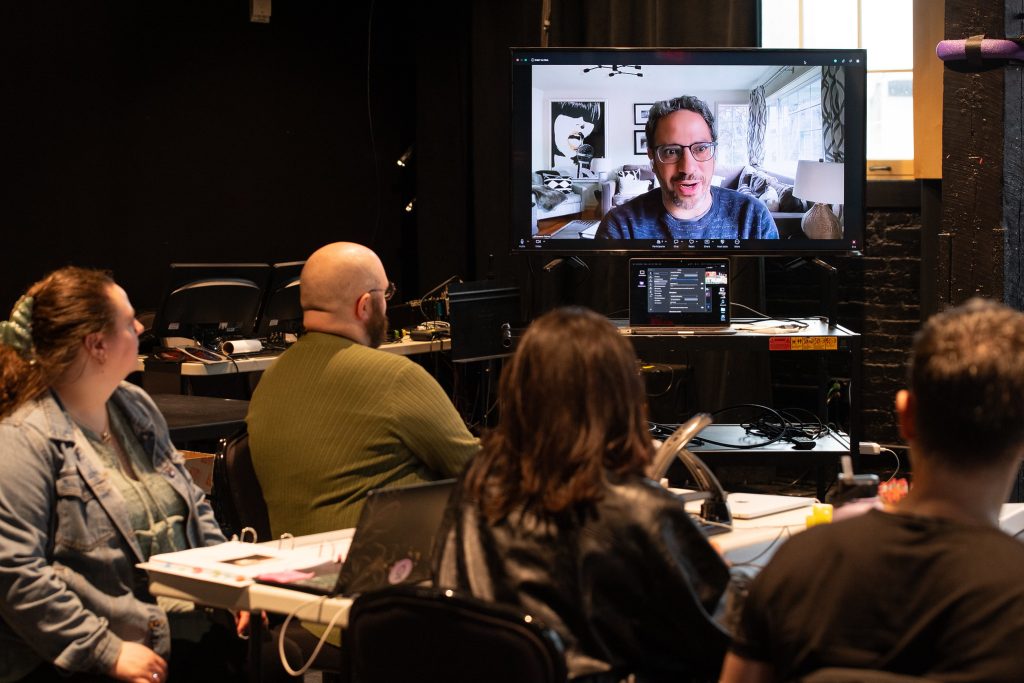
Playwright Kareem Fahmy speaks during the first rehearsal of “Dodi & Diana” in the studio at theREP in Albany, NY on Tuesday, March 31, 2026. Photo by Kevin Montano for Proctors Collaborative.
In “Dodi & Diana,” a couple’s relationship unravels over 72 hours, blending humor, identity, and emotional truth.
What if a single weekend could change everything you believe about love, fate, and the person sitting across from you? “Dodi & Diana” pulls you into exactly that kind of charged, intimate moment — a relationship at a breaking point, a clock ticking down, and a question hanging in the air: are we shaping our lives, or are they already written for us? It’s sharp, funny, seductive, and unpredictable, the kind of play that keeps you leaning forward, trying to figure out what will happen next and what it might reveal about your own life.
“The play doesn’t give you what you think it’s going to give you,” playwright Kareem Fahmy said. “It’s meant to surprise and hopefully delight you.”
Capital Repertory Theatre is honored to bring “Dodi & Diana” to the stage following the world premiere at Colt Coeur in New York City. Familiar to theREP, Fahmy’s “American Fast” and “A Distinct Society” were featured in past Next Act Summits.
The spark for the play came from a not fully formed concept, but from a gap in understanding — one that had been sitting quietly for years. “I remember just distinctly thinking… I know so little about Dodi Fayed,” he recalls. The realization came long after the 1997 crash in Paris that killed Princess Diana and Fayed, an event that remains one of the most widely remembered moments of the late 20th century.
Diana’s life has been endlessly examined, her marriage to Charles III, her humanitarian work and her global influence. But Fayed, despite being the son of Mohamed Al-Fayed and a film producer, often appears only in relation to her.
At first, the idea was almost conceptual, a title that quietly rebalanced the narrative. “I really liked the idea that I could write a play… putting his name first,” Fahmy said. But as time passed, and the 25th anniversary of the crash approached, the focus shifted.
“What if it’s not about Dodi and Diana,” he explained, “but what if it’s actually about the anniversary, and what it’s like to try to understand who those people were 25 years later?”
That question led Fahmy somewhere unexpected. Not into the past, but into the present. Instead of recreating historical figures, he built a fictional couple — two people navigating love, ambition, and the subtle, often unspoken imbalance that can exist between partners.
“If you’re in a romantic relationship where you feel… you might be overshadowed by the person that you’re with,” he says, “that dynamic could become something really complicated or potentially toxic.”
The play leans fully into that complexity. With just two characters on stage, it becomes an intense psychological portrait, one that asks where individuality ends and partnership begins. “Where in our relationships do we hold onto a part of ourselves and say, okay, this is me and that’s you,” Fahmy says, “and where do we become whole?”
Adding another layer is the idea of fate, specifically through astrology, a thread inspired both by Diana’s well-documented interest in spiritual advisors and Fahmy’s own experiences. “I went from being a skeptic to… not a believer in astrology writ large,” he says, “but I’m certainly a believer in the way it can offer insight and empathy.”
In the play, that belief takes form through a striking premise. The couple is instructed to be in Paris on the anniversary of Diana and Dodi’s death, at a precise moment dictated by an astrologer. It’s a decision that raises more questions than answers.
“What happens when you put yourself in the hands of fate versus driving your own destiny?” Fahmy asked.
The tension between those two forces — choice and destiny — drives the play forward, amplified by a ticking clock. With just 72 hours until something significant occurs, every conversation feels urgent, every silence loaded.
“When you have a sort of ticking clock… it kind of forces this momentum,” he explained. “You don’t want to waste a lot of time.”
Despite its intensity, the play isn’t unrelentingly heavy. Fahmy weaves humor and lightness throughout, creating a tonal balance that keeps the audience engaged. “The play is a little bit like champagne,” he says with a smile. “Very French, fizzy.” That effervescence makes it possible to explore deeper, more difficult emotional terrain without losing the audience along the way.
As the story unfolds, it resists easy conclusions. There are no clear heroes or villains, only shifting perspectives. “I wanted us to feel that at every moment… your allegiances and your empathies are sliding back and forth,” Fahmy said. “Which one do I relate to? Can I relate to both of them?”
That emotional ambiguity builds toward a pivotal twist, one that has sparked strong reactions from audiences — gasps, laughter, frustration, and admiration. For Fahmy, that range is a sign the play is doing its job. “All you want as a playwright is for an audience to not be bored,” he says. “There’s never no response.”
In the end, “Dodi & Diana” becomes something larger than its title suggests. It’s not just about two historical figures, or even just about the couple at its center. It’s about the ways we try to understand one another — across time, across relationships, across the unknowable spaces between who we are and who we’re meant to be.
“I don’t write the play for me,” Fahmy says. “I write it for an audience. I want them to have a really good time.”
Tickets are on sale now for “Dodi & Diana” at theREP April 24- May 17. Don’t miss this intimate, surprising story about modern relationships. Call or visit the Box Office at Proctors in-person or via phone at (518) 346-6204 Tuesday-Saturday 12 -6 p.m. or online attherep.org.

Marking 266 Years of Live Theatre in Albany
Written by Bennett Liebman, boardmember at theREP The year 2026 marks a major transition in the history of live theatre in Albany. It is the first year without Maggie Mancinelli-Cahill, whose remarkable 30-year tenure at Capital Repertory Theatre ended in 2025. It also marks Miriam Weisfeld’s first full year as... Read more » ... Read More

A season about freedom, connection, and community at theREP
At Capital Repertory Theatre, the 2026–27 season comes into focus not as a collection of individual titles, but as a unified exploration of how people live, choose, and connect. For Artistic Director Miriam Weisfeld, the shape of a season doesn’t always reveal itself right away. “You know it’s so funny.... Read more » ... Read More

Friendship is the secret ingredient in “Mystic Pizza” at Capital Repertory Theatre
Before the musical launches its national tour, Albany audiences can experience a heartfelt story powered by the chemistry of its three leading women Some stories endure because they remind us that life’s biggest moments are often shared around ordinary tables, during everyday conversations, and with friends who become family. That’s... Read more » ... Read More

Summer Studio 2026
Headshots Improv Workshop with BTTUNY Dance Rehearsal 7/24 Showcase 7/31 ... Read More

Celebrating the history of Capital Repertory Theatre
Court Miller and Janni Brenn, in “A Streetcar Named Desire.” Photo by Bert Castallanos Why does theREP Exist in Albany? Capital Repertory Theatre might seem like it has always been here. But where did it come from? In faded record boxes are blurry copies of the original articles of incorporation,... Read more » ... Read More